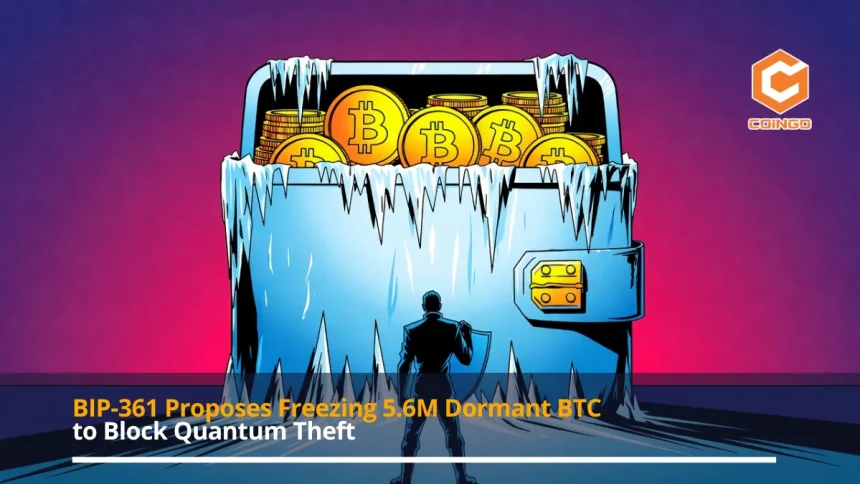
Bitcoin developer Jameson Lopp and a group of cryptographers have released BIP-361, a proposal that would phase out Bitcoin’s current cryptographic signatures and eventually freeze coins held in quantum-vulnerable wallets. Approximately 5.6 million BTC, worth roughly $420 billion at current prices, has not moved in over a decade and is considered likely lost. Lopp argues it is better to take those coins out of reach than let them fall to future quantum attackers. The proposal has ignited one of the fiercest governance debates in Bitcoin‘s history.
How BIP-361 Would Work in Three Phases
BIP-361 builds on the earlier BIP-360, which introduced a new transaction type called pay-to-Merkle-root (P2MR). This format strips out the key-based spending path that is exposed to quantum-era attacks, borrowing from Bitcoin’s Taproot framework while removing the vulnerable element.
The migration plan is structured in three phases. Phase A would activate three years after adoption, blocking new transactions to old-style quantum-vulnerable addresses. Phase B would restrict spending from legacy addresses, giving holders a final window to migrate. Phase C would permanently invalidate legacy ECDSA and Schnorr signatures, effectively freezing any coins that were not migrated to quantum-resistant addresses.
Holders who fail to move their coins would technically retain ownership but lose the ability to spend them. As Lopp described it, the action is closer to burning than confiscation, placing the funds permanently out of everyone’s reach.
Ethereum Foundation Launches Post-Quantum Defense Unit to Future-Proof the Network
28% of All Bitcoin Has Not Moved in Over a Decade
Lopp estimates that roughly 28% of Bitcoin’s total supply, approximately 5.6 million tokens, has been dormant for more than ten years and is most likely lost. A separate Google study from March placed the number of BTC in vulnerable addresses at approximately 6.7 million, a broader count that includes coins held in older address formats regardless of dormancy.
If quantum computing advances to the point where these wallets can be cracked, the recovered coins could flood the market and introduce severe volatility. But Lopp argued the bigger risk is psychological. Even credible evidence that someone has the capability to recover vulnerable coins would trigger panic selling across the network, regardless of whether a single coin is actually moved.
BIP-361 Key Figures
| Metric | Value |
|---|---|
| Dormant BTC (10+ Years) | ~5.6M BTC (28% of supply) |
| Estimated Value | ~$420 billion |
| Vulnerable BTC (Google Study) | ~6.7M BTC |
| Phase A Activation | 3 years after adoption |
| Proposal Status | Early stage, no timeline |
Community Backlash Centers on Ownership Guarantees
The proposal has drawn sharp criticism from parts of the Bitcoin community. The core objection is that freezing coins, for any reason, violates Bitcoin’s foundational guarantee of unconditional ownership. Leo Fan, founder of Cysic and former lead on quantum resilience at Algorand, summarized the concern: ownership becomes conditional, and holding keys no longer guarantees the ability to spend.
Community reactions on X ranged from calling the proposal “highly authoritarian and confiscatory” to comparing it to central planning with forced deadlines and behavior coercion. Some argued that any upgrade should remain 100% voluntary and that no protocol change should have the power to render existing holdings unspendable.
Fan did note an economic counterpoint: removing millions of BTC from circulation could tighten supply and potentially increase the value of remaining coins. But he stopped short of endorsing the freeze on those grounds.
Lopp: Quantum Recovery Would Reward “Vampires”
Lopp has been vocal about why allowing quantum recovery is worse than freezing. He described entities that would use quantum computing to sweep dormant wallets as “vampires feeding upon the system,” arguing that they would contribute nothing productive to the network while extracting enormous value.
The developers behind BIP-361 framed their work as defensive rather than offensive. Their stated thesis is that the Bitcoin ecosystem should actively defend itself rather than do nothing and allow a future attacker to destroy both value and trust. Lopp emphasized that he does not believe the freeze is necessary today, but views it as a contingency for a threat that is getting closer.
The Quantum Timeline Remains Contested
Recent research has shortened some estimates of when quantum computers could break widely used encryption. Zeynep Koruturk of Firgun Ventures noted that new findings suggest fewer physical qubits may be required to compromise RSA-2048, potentially shortening the timeline to two to three years if the results are confirmed in lab settings.
Others urge caution. Aerie Trouw, co-founder and CTO of XYO, said the practical threat remains distant enough that there is no reason to panic. The debate between urgency and patience mirrors the broader split in the community: those who want to prepare now versus those who believe the cure may be worse than the disease.