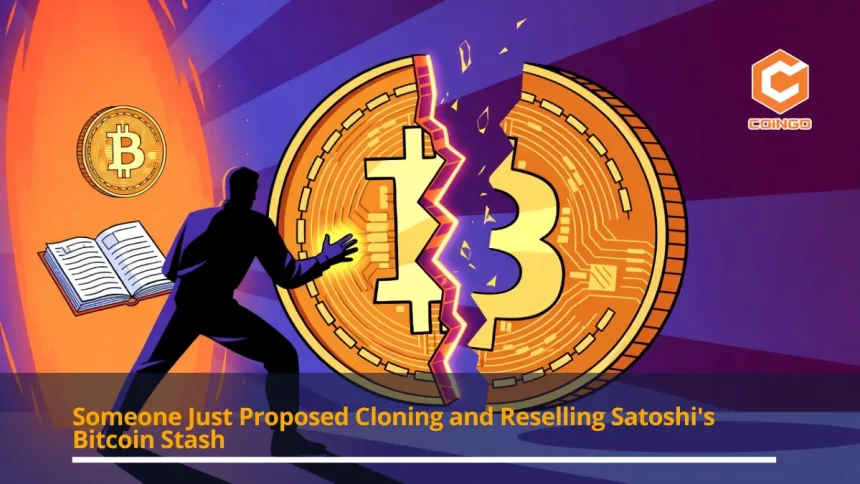
Paul Sztorc, the CEO of LayerTwo Labs, announced a hard fork on Friday called eCash. The mechanism is simple in description and radical in implication. The new chain would clone Bitcoin’s full history, then rewrite the ledger on the copy to take roughly 500,000 of the 1.1 million coins associated with Satoshi Nakamoto and assign them to people willing to pay for them today. Existing Bitcoin holders would receive matching balances on the new chain. Satoshi’s wallets would not.
The fork is targeted for August. The investor sale is open now. Whether anyone with money to put on the line takes it seriously is the open question.
How the Reassignment Actually Works
Sztorc cannot move Satoshi’s coins on Bitcoin itself. No one can. The proposal sidesteps that by creating a separate blockchain that copies Bitcoin’s history up to the fork date, then writes a new ledger on top. On that new ledger, the coins linked to the so-called Patoshi pattern — a mining signature researchers have associated with Bitcoin’s creator since at least 2013 — get reassigned.
Out of the 1.1 million coins in that pattern, fewer than half would be redirected to investors. Around 600,000 would stay assigned to Satoshi’s addresses on the new chain. Existing on-chain Bitcoin holders, the people who have a balance at the moment of the fork, would receive matching eCash on the new network. “Your coins will split,” Sztorc wrote on X. “For example, if you have 4.19 BTC, then you will get 4.19 eCash. You may sell your eCash, or keep it. Or ignore it.”
The investor pre-sale is the unusual part. Sztorc says people can buy a stake in the August fork now. Pay today, receive a slice of the cloned Satoshi coins on the new chain when it launches. He has framed this as the funding mechanism that prevents eCash from becoming what he called a “zombie” project — a fork without enough capital or contributors to actually go anywhere.
The Name Is a Callback to 1990s Crypto
eCash was originally the name of David Chaum’s digital cash project, launched in the early 1990s. Chaum is one of the foundational figures in cryptography. His blind signature scheme made it possible to create digital money that was both verifiable and anonymous. DigiCash, the company built around it, filed for bankruptcy in 1998 after failing to find adoption. The name has been mostly dormant since. Sztorc reusing it is intentional — the framing is that this fork is a continuation of an idea Bitcoin actually inherited from rather than a hostile spinoff.
The website lists Drivechain integration and seven sidechains under development. Drivechain is Sztorc’s long-running scaling proposal that has been debated inside Bitcoin for years and never adopted on the main chain. eCash would ship it by default.
Lopp Calls It a Publicity Stunt
Casa’s Jameson Lopp, the same Bitcoin developer behind the BIP-361 freeze proposal that has divided the Bitcoin community for weeks, was direct in his response. He told Decrypt the eCash fork is “clever outrage marketing” and emphasized that what is being moved is not actually Satoshi’s Bitcoin.
“It’s not Satoshi’s Bitcoin, it’s just unspent transaction outputs that are presumed to belong to Satoshi that are being cloned and modified onto a completely different network,” Lopp said. The distinction matters. Sztorc cannot reach into Bitcoin and take anything. He is starting a new chain and writing a new ledger on it. The Bitcoin held in Satoshi’s actual wallets stays exactly where it has always been.
Lopp acknowledged the proposal could in theory happen on Bitcoin itself. “If the entire Bitcoin ecosystem decided to migrate to a hard fork that reassigned Satoshi’s coins to keys that other people controlled, then sure, it’s theoretically possible,” he said. The probability of that consensus forming is, by Lopp’s framing, effectively zero.
Why Forks Like This Almost Always Lose
The history of Bitcoin and Ethereum forks is unkind to projects that split off from major chains. Bitcoin Cash forked in 2017 in a dispute over block size and scaling. It now trades at a fraction of Bitcoin’s price and processes a tiny fraction of its volume. Ethereum Classic emerged after the 2016 DAO hack when most Ethereum holders chose to reverse the stolen transactions and a smaller faction kept the original ledger. ETC has stayed around but has never come close to ETH’s market position.
The pattern is consistent. The original chain keeps the developer mindshare, the network effect, the infrastructure, and the institutional capital. The fork keeps a smaller community that values the specific change being made. Both chains technically work. Only one stays culturally and economically relevant. eCash would have to break that pattern to matter.
Sztorc’s framing on the eCash website acknowledges the bet directly. “The upside is enormous: global scalability, privacy, competition, rapid improvement, and adoption,” he wrote. “In fact, it may be a matter of life or death for Bitcoin. The downside is small: some drama, plus every Bitcoiner gets some free money.” The marketing reads as confident. The historical base rate does not.
Why This Is Landing Now
The timing of an eCash announcement in late April 2026 is not random. Bitcoin’s quantum vulnerability has moved from a theoretical concern to an active debate in a matter of weeks. Bitcoin developers reproduced IBM’s quantum cryptography results earlier this month. An Italian researcher executed the largest quantum attack on cryptographic keys to date. The BIP-361 proposal to freeze 5.6 million dormant Bitcoin to protect them from quantum theft is being argued in public on every Bitcoin forum and podcast. Satoshi’s coins specifically have been the focal point of every one of those discussions.
Sztorc is stepping into that conversation with a different answer. Instead of freezing Satoshi’s coins to keep them safe, hand them to investors who will use them. Instead of waiting for community consensus on the original chain, fork off and ship. The framing is provocative. Whether it is actually a serious technical proposal or, as Lopp suggested, marketing built on top of one of the most attention-grabbing ideas in the space, is what the next four months will determine. Most active Bitcoin wallets are reasonably safe from the quantum threat — Satoshi’s are not, and that gap is exactly what Sztorc is trying to monetize.
What to Watch Between Now and August
Three things will determine whether eCash matters or fades. The first is investor uptake. Sztorc is selling pre-fork allocations now. If serious capital shows up, that signals the proposal has institutional backing. If it does not, the August launch happens against thin demand. The second is exchange support. A fork without major exchanges listing the new token is functionally a fork without liquidity. Coinbase, Kraken, and Binance have not weighed in publicly. Their decisions in the weeks before launch will tell most of the story.
The third is whether the broader Bitcoin community treats this as a legitimate alternative or an opportunistic move. Bitcoin Cash and Ethereum Classic both had moments where they could have established themselves as serious alternatives. Both lost those moments. Sztorc has 119 days to get more traction than either did at launch. The marketing is ready. The adoption is the part that has to be earned.