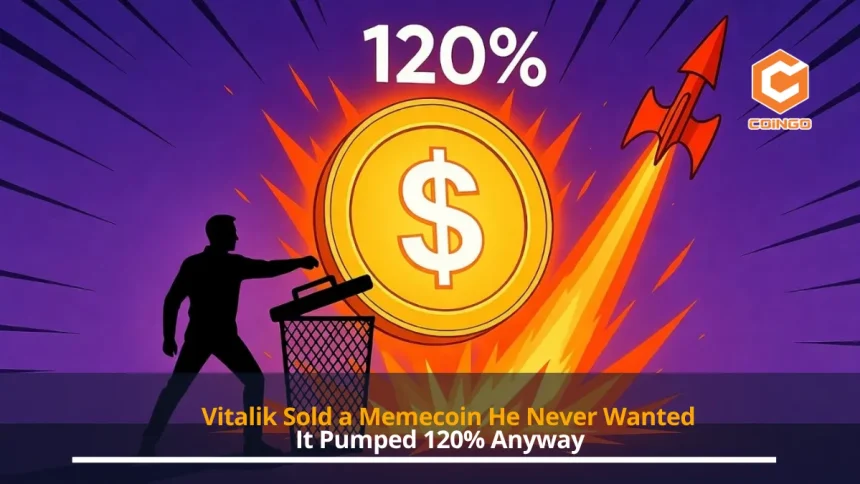
Vitalik Buterin sold roughly $114,600 worth of ASTEROID OG tokens on April 29 — about 40 million units of a memecoin that landed in his wallet without his permission. The token responded by rallying 120% within hours of the sale. The total value of the unsolicited memecoins he liquidated in this round comes to over $260,000, and the entire sequence is a textbook example of how the relationship between Vitalik’s wallet and memecoin markets has flipped in 2026.
Five years ago, when Vitalik moved or sold tokens that had been sent to him as a marketing stunt, prices crashed. SHIB is the textbook case. The Ethereum founder dumping his airdropped supply was treated as a vote against the project, and the market priced it accordingly. That is no longer how this works.
What Actually Happened on April 29
Onchain data showed a single transaction moving approximately 40 million ASTEROID OG out of one of Vitalik’s known wallet addresses, valued at roughly $114,600 at the time of the trade. The tokens hit the open market through a decentralized swap. Within hours, ASTEROID OG was trading 120% above its pre-sale price.
ASTEROID OG was not a token Vitalik bought or held by choice. The project sent it to his wallet, along with countless others, hoping for the kind of association-by-proximity that has been a memecoin marketing tactic for years. The strategy is straightforward. If a high-profile wallet holds a token, retail traders treat that as a signal of legitimacy, even when the wallet’s owner had nothing to do with receiving it. The same token had already shown what attention alone can do — earlier this month, a single one-word reply from Elon Musk sent ASTEROID up 68,000% in under a week. The Vitalik sale is the second act of the same story.
Vitalik’s response has been consistent for years. He sells. The proceeds typically go to research foundations, public goods funding, and humanitarian causes. His position on the entire scheme has been openly hostile — he has asked projects publicly to stop sending him tokens. They keep doing it anyway, because the marketing payoff is real.
The Inversion: Selling Used to Crash Tokens. Now It Pumps Them.
The most interesting part of the April 29 sequence is the market reaction itself. In earlier cycles, a Vitalik dump was treated as a sell signal. The thinking was logical: the most respected technical figure in the Ethereum ecosystem just liquidated this token, so why would anyone else hold it? Prices fell sharply. The 2021 SHIB liquidation is the canonical example.
What happens now is the opposite. Memecoin traders look at a Vitalik sale as a publicity event rather than a fundamental signal. The token gets attention. Attention drives speculation. Speculation drives price. The logic of “Vitalik dumped, therefore I should buy” makes no sense as a fundamental analysis. It makes complete sense as a momentum trade in a market where attention is the primary input.
This shift says less about Vitalik than it does about the structure of the memecoin market in 2026. Tokens with no utility, no revenue, and no roadmap can still command billions in market cap if they capture attention. ZachXBT’s recent investigation into MemeCore’s $6 billion valuation and the broader pattern of concentrated insider holdings in headline memecoins illustrate the same dynamic from a different angle: market caps are being driven by narrative, not fundamentals. The Vitalik sale is a clean case of that dynamic in action.
Why Sending Tokens to Famous Wallets Still Works
From a marketing standpoint, sending free tokens to Vitalik’s wallet is one of the cheapest ways to generate attention for a memecoin launch. The cost to the project is the gas fee plus the value of whatever tokens they allocate to the giveaway. The upside is being able to point at onchain data showing that Vitalik holds the token, even if he never asked for it and never endorsed it. Most retail traders do not look closely enough to notice the difference.
The deeper question is how memecoin tokenomics actually work when this kind of distribution is the launch strategy. Reading a project’s supply schedule becomes nearly impossible when the founders’ actual control over the float is hidden behind unsolicited transfers to celebrity wallets. The optics of a wide distribution are manufactured. The reality is concentrated supply with distributed plausible deniability.
Vitalik has been explicit that he does not want this attention and does not consider his wallet’s holdings to constitute any kind of endorsement. The actions match the words. He sells, he donates the proceeds, and he publicly asks projects to stop. The market hears him on the words and ignores him on the actions. The volume of unsolicited token deliveries to his addresses has not slowed down. The price reactions to his sales have inverted. Both data points say the same thing: in memecoin markets, the only signal that matters is attention itself.
Where the Proceeds Actually Go
One detail that consistently gets lost in coverage of these sales is what Vitalik does with the money. The proceeds from unsolicited token liquidations have historically been donated to causes including Ethereum protocol research, longevity science, COVID-19 relief in 2020 and 2021, and pandemic preparedness initiatives. The exact destination of the April 29 ASTEROID OG proceeds has not been publicly disclosed yet, but the pattern is established.
This creates a strange asymmetry. The memecoin projects sending tokens are running a manipulation scheme. The recipient is converting those manipulation attempts into charitable donations. The market is rewarding both sides simultaneously. The token gets attention and pumps. The cause receives funding it would not otherwise have. The only people who reliably lose are the retail traders who buy in after the pump and hold past the next cycle of attention.
What This Says About 2026 Memecoin Markets
The Vitalik sale is a small data point on its own. As an indicator of where memecoin markets sit structurally in 2026, it is more revealing. Three things are now consistently true. The marginal buyer in memecoin trades is not analyzing fundamentals. The signals that used to provide downside information — insider sales, founder distance, public criticism — have inverted into upside catalysts. And the most cynical market participants are not the projects sending tokens to celebrity wallets. They are the traders who recognize the inversion and trade it deliberately.
The pattern holds across the broader category. NEIRO surged 70% in a week as the memecoin sector caught another wave of attention, with no underlying fundamental change to explain the move. Vitalik will keep selling. The projects will keep sending. The price reactions will keep being unpredictable in the same predictable direction. The cycle is now self-sustaining, and the only honest read on it is that memecoin price action in 2026 is no longer pretending to be anything other than attention arbitrage with extra steps.