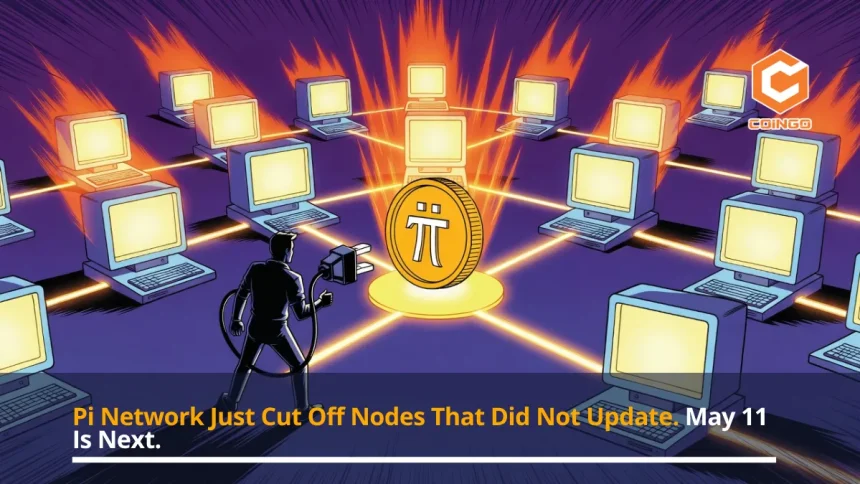
The hard deadline arrived on April 27. Every Pi Network mainnet node still running v21.2 software at that point was automatically severed from the network. No transactions, no block validation, no consensus participation, no node rewards until they upgrade to Protocol 22.1. The Pi Core Team confirmed that downgrading to an earlier version is not allowed once a node completes the transition.
What just happened is significant for one of the largest single-token communities in crypto. Around 421,000 active nodes power the Pi network across more than 1 million CPUs. Operators who missed the cutoff are now offline. The next deadline lands in two weeks, and it carries more weight than the one that just passed.
What the Upgrade Actually Required
The mechanics were straightforward but unforgiving on timing. Operators had to update their software to version 0.5.4. The whole process takes under 15 minutes if done correctly. The trick was sequencing. Nodes could not all be upgraded simultaneously without breaking network stability, so operators were instructed to redirect traffic to other nodes or point to the official API endpoint during the transition.
Protocol 22.1 also introduces a dual-interface setup. Node operators can now use both a node screen and a desktop Pi application at the same time, which means balance checks and network features are accessible from a computer rather than only a phone. This is small in feature scope but meaningful for usability — until now, Pi has been mostly mobile-first, which has been a friction point for serious operators.
A pilot with OpenMind AGI confirmed that Pi’s distributed node network can handle decentralized AI image recognition and training tasks. That is the kind of capability the team has been signaling for months. Whether it gets used at scale is a separate question, but the technical path is now demonstrated.
Protocol 23 Just Got Pulled Forward to May 11
The bigger update from the Bitget technical guide is the schedule shift. Protocol 23.0, originally targeted for May 18, has been moved one week earlier to May 11. This is the upgrade that matters.
Protocol 23 introduces full smart contract functionality across the Pi Network. The chain transitions from a transactional system into a programmable platform. Developers can build decentralized applications, exchanges, and automated tools on top of it. Pi has spent years trying to position itself as more than a phone-mining curiosity. Smart contracts are the technical bridge to that positioning.
The earlier deadline aligns the launch with Consensus 2026 in Miami, scheduled for May 5 to 7. Pi co-founders Nicolas Kokkalis and Chengdiao Fan are both speaking at the event. The timing is not random. Going on stage at a major industry conference with a smart contract launch days away gives the team a marketing window they can use.
Four additional protocol upgrades have been added to the summer roadmap behind Protocol 23. Protocols 24.1, 25.1, and 26.0 are now scheduled to follow. The pace is unusual. Most chains ship one major upgrade per quarter at most. Pi is targeting five protocol milestones across a roughly ten-week window from late April through late June.
Why the PI Token Did Not Move
PI is trading near $0.17 with a market cap around $1.73 billion as the deadline hit. The token fell roughly 4% in the week leading up to it, even as Bitcoin and other major assets rallied on improved Iran ceasefire sentiment. The market consistently treats Pi technical milestones as sell-the-news events rather than catalysts for re-rating, and Protocol 22 has followed exactly that pattern.
The supply side explains a lot of the pressure. Pi Network is sitting under a $231 million token unlock cycle that has been weighing on price for months, and roughly 200 million PI tokens are scheduled to unlock over the next 30 days specifically. About 3 million PI moved to centralized exchanges in the days before the deadline, raising near-term selling concerns. This week’s broader altcoin unlock schedule has only added to the supply pressure across the small-cap segment.
Price reactions to Pi upgrades have followed the same shape three times in a row now. Anticipation builds before the deadline, the deadline arrives, the upgrade succeeds, and the token drifts lower or sideways for the next two to four weeks. Whether Protocol 23’s smart contract launch finally breaks that pattern is the question. The setup is at least more interesting than it has been before — smart contracts are a structural change, not just an infrastructure tune-up.
What to Watch in the Next Two Weeks
Three things will determine whether Protocol 23 actually means anything. The first is how many of the 421,000 active nodes are still operational after April 27. Numbers should start surfacing within days. A meaningful drop signals operators struggled with the upgrade. A small drop signals the community handled it cleanly.
The second is what the team announces at Consensus 2026 between May 5 and 7. Smart contract launches are often technical milestones first and adoption stories later. If Pi has actual partnerships, applications, or developer commitments to announce on stage, the May 11 launch becomes a real event. If not, it becomes another sell-the-news cycle.
The third is whether anything builds on top of Pi after the smart contracts go live. The chain has size — 10 billion PI tokens have already migrated to mainnet, and the user base is among the largest in crypto. What it has not had is meaningful developer activity. Smart contracts give developers a reason to look. Whether they actually build is the part that has not been answered yet.